

Since 2013, thousands of people have been killed in the Central African Republic, and many victims were buried in informal or makeshift graves, including mass graves. In addition, some bodies were thrown into wells and latrines. In most cases, there is a lack of systematic preliminary investigation to identify the human remains, which hinders the right of family members to the truth and their ability to ensure a dignified burial for their loved ones.
The institutions involved generally lack access to the specialized training needed for effective forensic investigations. The dearth of collected evidence hinders criminal investigations, undermining the possibility of holding perpetrators accountable for war crimes and grave human rights violations. Compounding this situation is the fact that, in recent years, numerous exhumations have been conducted for health and sanitation reasons without forensic expertise. Consequently, without proper analysis of the remains or the capacity for scientific identification, there is a risk that vital evidence of war crimes will be destroyed.
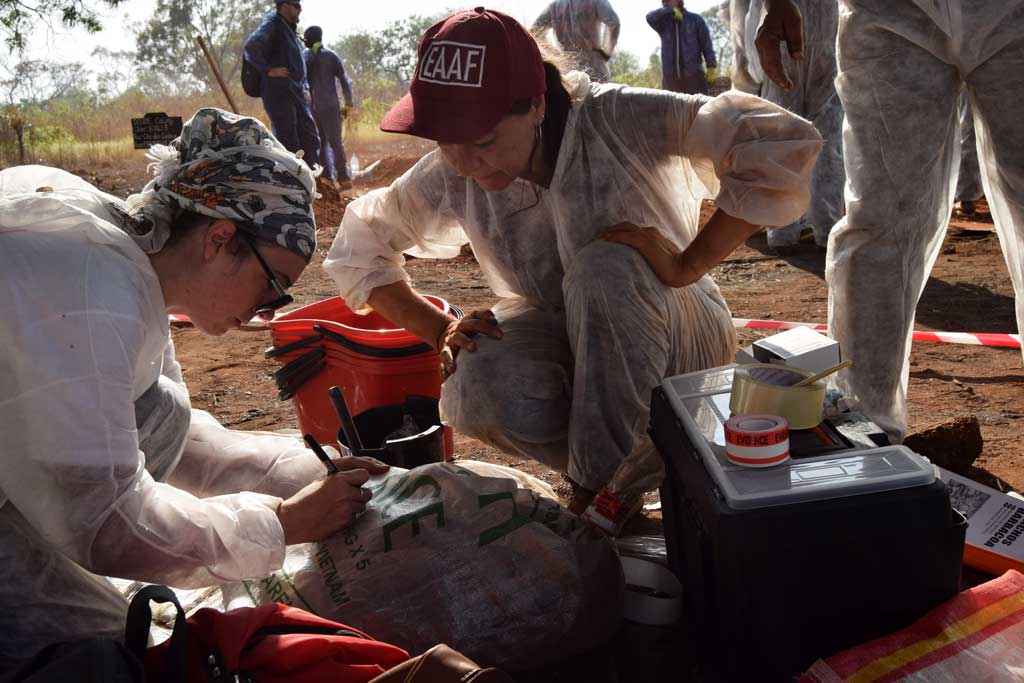
To address these difficulties, the Columbia Law School Human Rights Clinic and the Argentine Forensic Anthropology Team (EAAF) launched a project (“Clinic-EAAF”) in close collaboration with the Central African Republic’s government.
To date, the Clinic-EAAF has been the first and only organization to conduct multiple, complex forensic investigations into these crimes. These investigations provide evidence for future trials and were also used to train local stakeholders in forensic procedures. They also enabled victims’ families to recover the remains of their loved ones and provide them with dignified burials.
The project trained a wide range of actors, including judges, the gendarmerie and police, victims’ associations, NGOs and medical students, using an innovative training model centered around hands-on learning.
Legal workshops were also held, bringing national and international experts together with local stakeholders to analyze gaps in the Central African Republic’s current legal framework for forensic investigations, to identify key challenges and priorities for future reforms and to draft proposals for revising relevant legislation. The Clinic-EAAF has also provided consulting on drafting the rules of procedure’s provisions on exhumations and expert witnesses for the Special Criminal Court (CPS in French).
It has identified, collected and analyzed information on more than 100 alleged incidents of mass killings to create a centralized repository of information that may be of interest to judicial authorities or to truth and reconciliation commissions. And it has carried out renovations at the Bangui morgue to ensure that multiple bodies can be processed simultaneously and to address the needs of investigations related to mass killings.
In 2017, EAAF made two trips to the Central African Republic: one for the Boali case, where it exhumed and analyzed the remains of 12 victims of a massacre; and another in November to reanalyze mixed remains from the same case based on genetic results, while also preparing expert reports and returning the remains to families. The Team also worked on the Camp Béal and Bossembélé cases.