

GLOBAL WORK
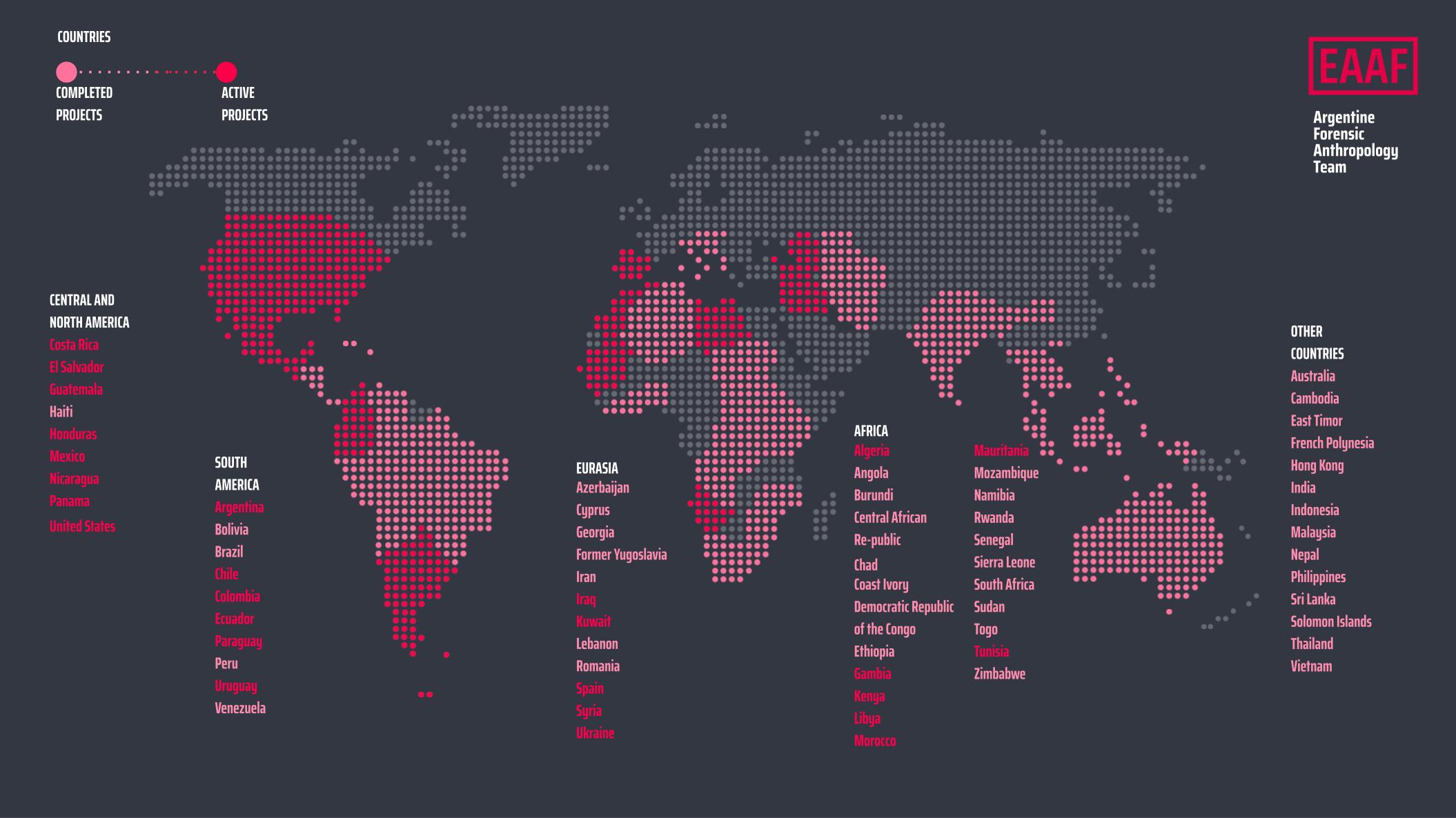
The Argentinian Forensic Anthropology Team is an international organization capable of intervening wherever forensic work is needed to search for, recover, analyze and identify missing or disappeared persons. It has the ability to organize forensic searches, design databases, set up forensic anthropology laboratories and process samples in missions worldwide.
Globally, it is called upon by victims’ families, courts and special tribunals, humanitarian organizations, special commissions, and states. Its work began in Latin America, and is most extensive there, but since the 1990s it has operated in all regions. To increase the effectiveness of its interventions and build lasting ties with local actors, EAAF is organized into different divisions that are familiar with the context in each country or region.
ARGENTINA
EAAF was founded in Argentina and is headquartered in Buenos Aires. Since 1984, it has worked on the comprehensive investigation of disappearances and murders committed by the state terrorism regime between 1974 and 1983, serving as an official expert for the federal judicial system.
Building on that experience, its other main focus is the investigation of disappearances under democratic rule. EAAF emphasizes families’ needs and coordination with prosecutors’ offices and courts throughout the country to examine cases of missing persons and unidentified buried bodies, and to consolidate a national database.
The Team is also part of the Islas Malvinas/Falkland Islands Humanitarian Project aimed at identifying Argentine combatants who perished on the islands and were buried without identification. This project is coordinated by the International Committee of the Red Cross (ICRC).
EAAF provides local and regional courses and training programs through the International Center for Training in Forensic Sciences, located at the Memory and Human Rights (ex-ESMA) site in Buenos Aires.
AFRICA
EAAF has a branch in South Africa that participates in the investigation, recovery and identification of persons who went missing under Apartheid. Between 2012 and 2019, it ran the African School of Humanitarian Forensic Action in cooperation with the International Committee of the Red Cross (ICRC). Professionals from 28 countries were trained there, establishing a broad regional professional network. The Team has also intervened in numerous truth and justice processes in post-dictatorship or post-conflict settings, such as the crimes committed in The Gambia (1996–2017) and recovery of the remains of South African soldiers who died in exile in Zambia and Zimbabwe. Furthermore, at the request of the Extraordinary African Chambers, it conducted forensic investigations in Chad that formed part of the evidence used to sentence dictator Hissène Habré to life imprisonment, in May 2016.
The South Africa branch, in conjunction with EAAF’s Eurasia and Middle East branch, is carrying out a transnational and multi-institutional project that has taken its first steps to address the disappearances that occur during migration from northwestern Africa to southwestern Europe.
CENTRAL AND NORTH AMERICA
In this region, EAAF has an office in New York and a branch in Mexico City, where it has been working continually for 20 years. It focuses on contributing to the development of responses to mass disappearances, coordinating with state governments and prosecutors’ offices, and serving as an expert witness for families and local NGOs. Among other cases, it serves as an expert witness for the families of the 43 students from Ayotzinapa who were disappeared in Iguala in 2014.
EAAF manages the Border Project (Proyecto Frontera) from this division, in partnership with state and civil society actors at the regional level. Through forensic databases, information from families of missing migrants is compared with that of unidentified bodies found along migration routes from Central America to the United States.
At the same time, the region works on forensic training and public policies, collaborating on the design of mechanisms for identification and roundtables on missing migrants, among other initiatives.
SOUTH AMERICA
Almost since its inception, EAAF has worked in South American countries beyond Argentina, addressing disappearances due to political violence through search, identification and training efforts.
In the Southern Cone, Operation Condor remains a central focus of work that continues to this day. EAAF has worked on numerous forensic investigations in Bolivia and was called upon to search for the remains of Ernesto Che Guevara. In Chile, it assisted in analyzing the cases related to the deaths of Salvador Allende and Pablo Neruda, as well as the Patio 29 incident. Between 1991 and 2021, EAAF traveled to Colombia on multiple occasions to offer case consultation and training.
Today, it provides ongoing forensic training to government agencies and local organizations throughout the region, particularly through the Latin American School of Forensic Sciences and Human Rights.
EURASIA
EAAF carries out missions in Eurasia and the Middle East, which are often requested by the International Committee of the Red Cross (ICRC). It organizes and coordinates these missions from its branch for the region, located in Madrid.
Its notable work in this region includes involvement in Syria, Lebanon, Iran and Iraq; ongoing missions in Ukraine (since 2015); and the establishment of an International Forensic Science Training Center in Cyprus, where the Team helped create a local mechanism for identification that it continues to advise.
A joint project by EAAF’s Madrid and South Africa branches aims to address disappearances occurring during migration from western Africa to southwestern Europe, as part of a transnational and multi-institutional initiative that has taken its first steps.