

In September 1996, when a civil war began in the eastern part of the country, thousands of Rwandan Hutu refugees fled the violence, traveling westward through the rainforest to reach the outskirts of the city of Mbandaka (capital of Équateur province) by late April 1997, just as the civil war was ending. In response, with support from the provincial governor, several local organizations – including the Catholic Church, the Protestant Church, Caritas, the Red Cross and Médecins Sans Frontières – established a Reception Committee. On May 13, troops from the Alliance of Democratic Forces for the Liberation of the Congo (ADFL) killed thousands of the refugees.
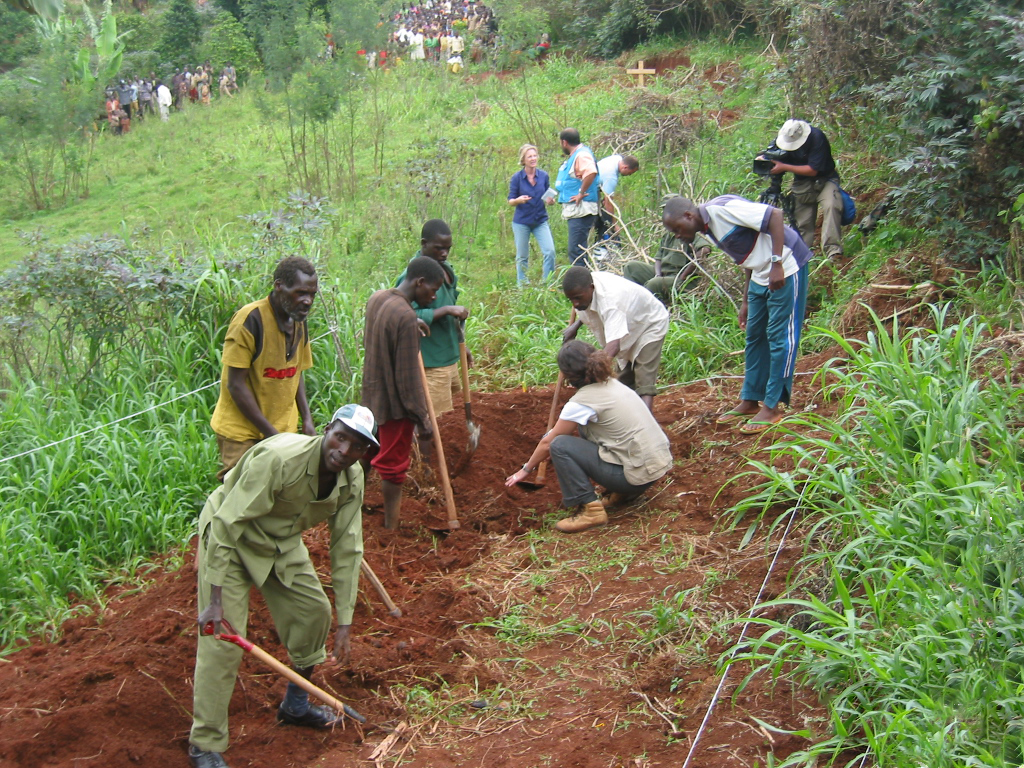
According to various sources, most of the refugees killed in Mbandaka were thrown into the Congo River. Others were left out in the open. The local Red Cross took charge of collecting their bodies and burying them in mass graves. In 1997, EAAF coordinated forensic efforts with the United Nations Centre for Human Rights and the International Forensic Team in the Democratic Republic of the Congo to investigate severe human rights violations committed primarily against refugees. The first mission – as part of an investigation by the United Nations Secretary-General’s fact-finding mission on human rights violations – involved exhuming a suspected mass grave in Mbandaka. The Team gathered information about the location, conducted fieldwork, and provided a series of recommendations for continuing the process.
In 2002, EAAF members returned to the Congo for an assessment mission. A total of 30 exhumations were carried out during EAAF’s various interventions.