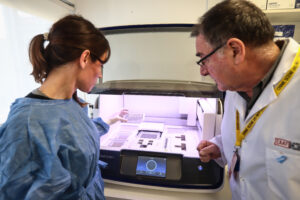
FORENSIC GENETICS LABORATORY
Founded in 2006, EAAF’s Forensic Genetics Laboratory (LGF-EAAF in Spanish[HB1] ) is specialized in processing long-standing skeletal remains, and its work serves as a benchmark. It has the distinction of having been created as part of a team dedicated to identifying missing persons, which allows it to integrate information from investigative and anthropological efforts into its work processes.
The LGF-EAAF is accredited under ISO/IEC 17025:2017. Test laboratory accredited by the OAA[HB2] with accreditation No. LE 281. (See the accredited scope at www.oaa.org.ar).
It can process between 700 and 800 bone samples per year and an equivalent number of samples from the relatives of missing persons.
It occupies over 200 square meters and has a staff of seven biochemists led by Carlos Vullo, PhD in Chemical Science[HB3] . Its members have published more than 50 scientific articles on forensic genetics.
In the laboratory, reference samples obtained from the blood or saliva of missing persons’ family members are processed and compared with DNA obtained from bone samples or dental pieces belonging to recovered unidentified bodies.
CAPABILITIES
Genetic Markers: The LGF-EAAF analyzes up to 40 nuclear DNA genetic markers, which have a high power of discrimination. It also analyzes mitochondrial DNA, which, due to its characteristics, is highly useful for severely degraded samples.
These same markers are used by other world-class forensic genetics laboratories, enabling the comparison of results obtained across different scientific centers.
Mass Comparison:
- The LGF-EAAF uses the DNA-VIEW mass comparison software, which allows for comparing a large number of genetic profiles of family members with the genetic profiles of unidentified skeletal remains, in order to facilitate their identification.
- It also utilizes the M-FISys®️ (Mass Fatality Identification System) software, which has enormous potential for the identification of large numbers of disappearances as well as for use in forensic criminalistics[HB4] . M-FISys®️ combines and compares multiple genetic, anthropological, familial and circumstantial data to perform forensic identifications.
Massively Parallel Sequencing (MPS): This next-generation technology used by EAAF enables, for example, parallel mass sequencing of genetic data, which allows for the simultaneous analysis and comparison of multiple DNA markers, thereby enhancing its identification capacity.[HB5]
FIGURES AND COUNTRIES
Since 2006, more than 5,500 bone samples from potentially missing persons and more than 12,000 reference samples from the relatives of missing persons have been processed. More than 1,400 identifications have been made across different projects.
Over 700 victims of enforced disappearance in Argentina between 1974 and 1983 were identified through genetics, with positive identification defined as a 99.99% or more probability of identity.
The LGF-EAAF can work on projects for EAAF or for other parties that only need support in genetic analysis. Since its creation, the laboratory has identified missing or disappeared persons in the following countries:
The Americas: Argentina, Bolivia, El Salvador, Honduras, Mexico, Panama, Paraguay, Peru, Uruguay.
Africa: Angola, Central African Republic, Chad, Nigeria, South Africa, Uganda, Zimbabwe.
Europe: Spain.
Asia: Timor-Leste, Vietnam.[HB6]
Oceania: Australia, Solomon Islands.
OTHER LABORATORIES
EAAF also uses other laboratories to process samples and produce genetic data. Since 2008, the laboratory of Bode Technology Group Inc. (Virginia, USA) has been used for the processing and mass comparison of samples that are not severely compromised or degraded, while EAAF’s own genetic laboratory is used for more complex cases. In some cases involving remains in a very critical state, EAAF also works with the forensic laboratory at the University of Innsbruck. For example, EAAF has sent highly degraded samples there from the investigation into the disappearance of 43 students from Ayotzinapa, Mexico.
