

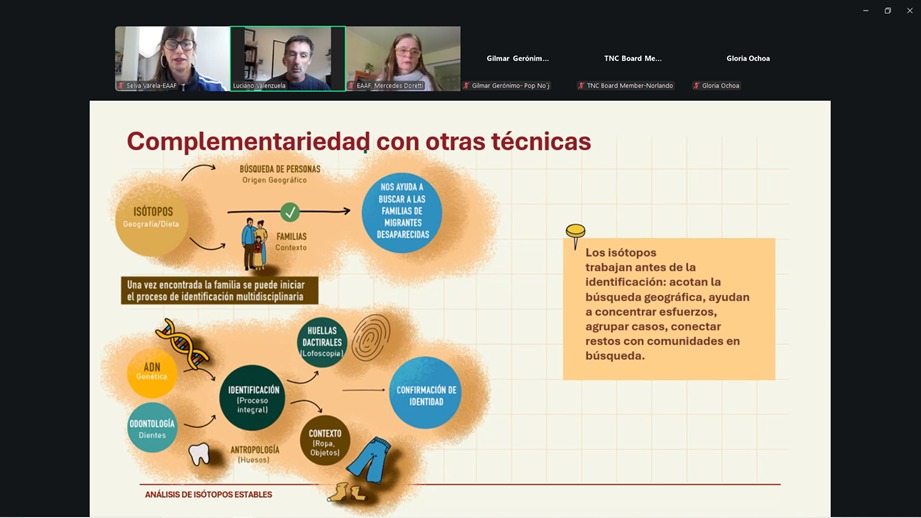
The EAAF and Luciano Valenzuela, EAAF consultant and researcher at CONICET and the National University of Central Buenos Aires Province, delivered the workshop “Stable Isotopes for the Search for Missing Persons,” aimed at family collectives, non-governmental organizations, and journalists from Mexico, Guatemala, El Salvador, Nicaragua, Honduras, and Ecuador. Mercedes Doretti, Director for Central and North America, presented at the training on behalf of EAAF.
The analysis of stable isotopes is a methodology that measures the presence of chemical elements in human tissues, such as teeth or hair. The objective of this analysis is to establish the geographic regions of birth or residence of an unidentified deceased person. This technique is used to narrow down search areas and guide the location of families, although it does not generate a direct identification. Therefore, the collaboration of family members is necessary for the creation of isotopic reference databases, where each donated sample is an act of solidarity with families in search.
The workshop, held over two days for different participants, included members of various regional organizations, among them Fuerzas Unidas por Nuestros Desaparecidos from Nuevo León, Mexico; the Equipo de Estudios Comunitarios y Acción Psicosocial, the Red Jesuita con Migrantes, and the Asociación Pop No’j from Guatemala; representatives from the Fundación para la Justicia y el Estado Democrático de Derecho from Mexico and Redacción Regional from El Salvador; Unidos por la Esperanza from Honduras; and the Texas Nicaraguan Community and the Asociación de Familiares y Amigos de personas Desaparecidas from Ecuador.
Members of the German Agency for International Cooperation (GIZ) also participated, financially supporting the workshop under the framework of the Project for Strengthening the Rule of Law in Central America and the Caribbean (FEDACC III).